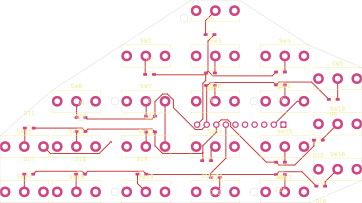
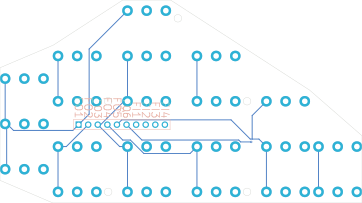
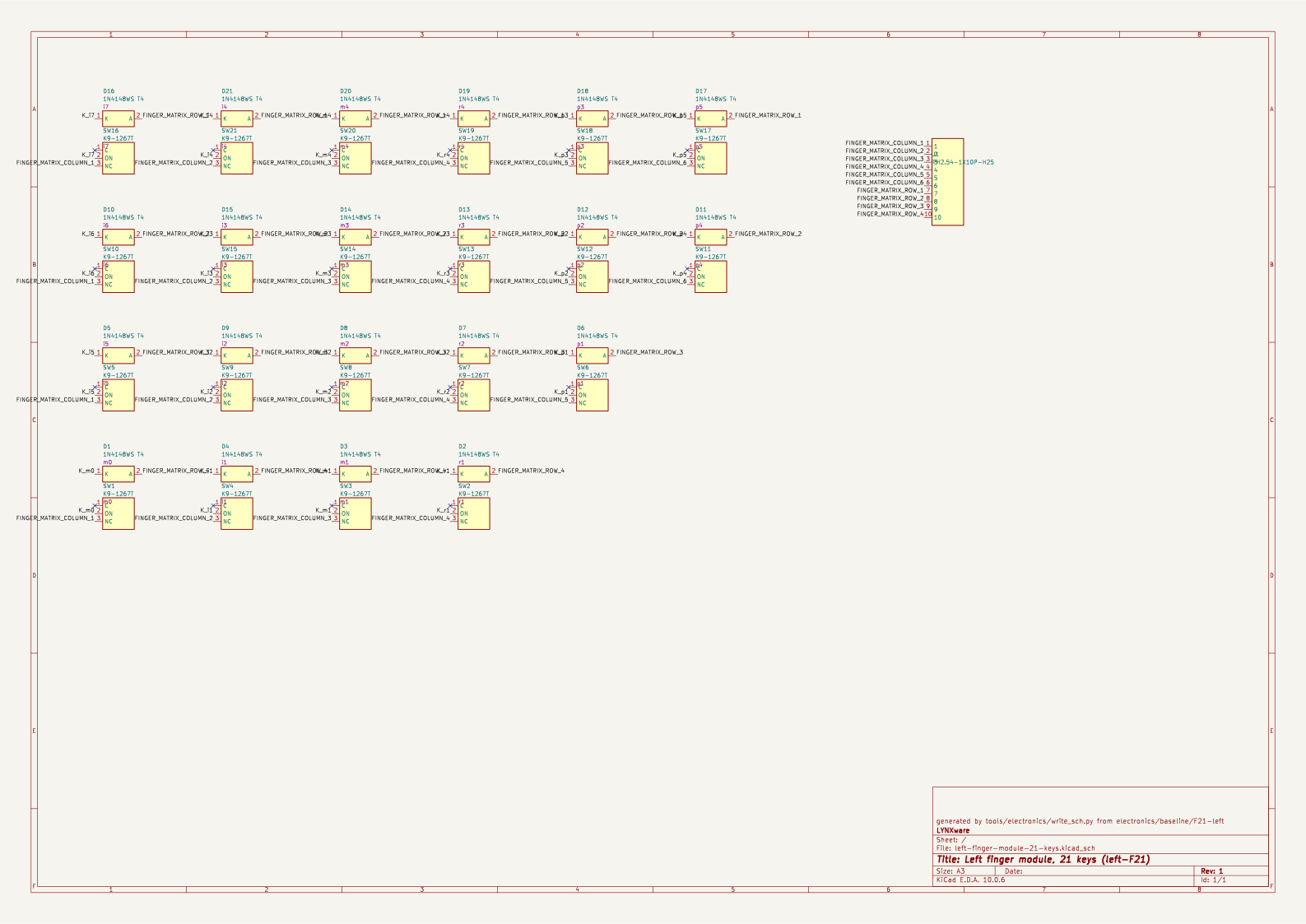
Left finger module, 21 keys (left-F21)
Redrawn in KiCad from its EasyEDA Pro source like left-T11, through the
qualification gate. Source of truth: still the frozen
export (ProPrj_CAT-v4_Finger_Left_Keys-21_2026-08-01.epro2 in the private EasyEDA archive,
board left_finger-module_keys-20_v0.4.0 — the title predates the 21st key) until the gate is
ticked. Generated from electronics/baseline/F21-left/: placed and routed with the source's
copper, trace for trace. No deviations from the source.
Parts: SW1…SW21 K9-1267T with D1…D21, numbered in reading order; SW1 is key m0, the 21st
key on the board's tab (cell (3,0), the right board's wheel button position). J1 the 1×10
header (C42431810) on the bottom. No LEDs, no pour.
Gate record (2026-09-25)
| Step | State | Evidence |
|---|---|---|
| Archive the original export | ✅ | sha256 36622958…0014b1 |
| Produce the KiCad project | ✅ | generated, deterministic, saved by kicad-cli 10.0.6 |
| Resolve symbols, footprints, 3D models | ✅ | check_lib.py left-F21; the project's own library since 2026-09-26 (electronics/lib/README.md), copper unchanged |
| Schematic ↔ PCB association, parity | ✅ | pcb drc --schematic-parity: no entry — nets, unconnected pins and Key fields as KiCad derives them from the schematic |
| Diff connectivity | ✅ | 94 connected pads, 31 nets, both directions; 21 no-connects (every switch's pin 1) |
| Diff placement | ✅ | every pad within 0.01 mm |
| Diff outline, holes | ✅ | 95.885 × 53.721 mm, 9 vertices; 5 holes Ø2.0 |
| Keys vs the Assembly | ✅ | 21 cells, Key fields = LYNXware.toml |
| Connector labels | ✅ | silk aliases FO1…FO6, FI1…FI4 of the FINGER_MATRIX_COLUMN_* / FINGER_MATRIX_ROW_* signals (wiring-harness.toml) |
| Diff copper | ✅ | all 168 source traces and the via at their source position, width and net; every net one piece, DRC 0 unconnected items |
| ERC / DRC | ✅/⚠️ | 0 errors; five source edge pads as warnings (below); inherited silkscreen warnings |
| Human review | ⏳ | Stas, in KiCad |
Findings
- Outer switch pads cross the board edge.
SW5,SW10,SW16pad 3 (the index outer column's right-hand pads) reach 0.033 mm past the right edge;SW11,SW17pad 1 (pinky outer column) 0.042 mm past the left edge — in the source too. Named inleft-finger-module-21-keys.kicad_dru. - The library footprints' silkscreen runs past the board edge at the outer columns (57
silk_edge_clearancewarnings) and over pads. Cosmetic; the fab clips it.
Hand-over
⚠️ Stas: open left-finger-module-21-keys.kicad_pro in KiCad 10.0.6 and review; "Update PCB from Schematic"
should report no change. Then tick "Human review".